
Rule 1: Understand Why Change Efforts Fail
To succeed at making change happen, start by understanding why change efforts so often fail. Research finds that change initiatives fail about 80% of the time. That working number applies across change efforts in business, education, and certainly in government. Failure analysis is helpful—understand what causes failure and avoid it.
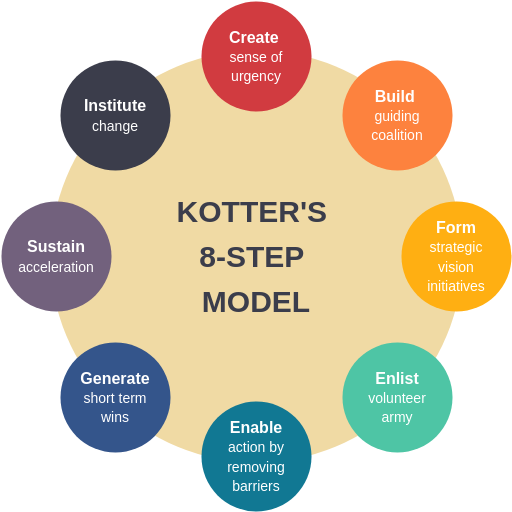
According to leadership expert John Kotter, change programs primarily fail because leaders rush the process and skip critical steps. In his foundational Harvard Business Review framework, he identified eight common errors that derail transformation efforts, ranging from creating complacency to failing to embed new habits into the corporate culture. [1, 2, 3, 4, 5] The Key Finding is don't fail to do any of these steps—omission means the change will crash.
Allowing Complacency Instead of Creating Urgency
Not establishing a great enough sense of urgency: Without a compelling reason to change, people won't rally behind the initiative.
Declaring victory too soon: Leaders often celebrate minor, early successes as the final war won, prematurely letting up on the momentum needed for deep, lasting change. [1, 2, 3]
Leadership and Vision Issues
Not creating a powerful enough guiding coalition: Change requires a dedicated, influential team to lead the charge; one person or a weak committee cannot drive large scale change.
Lacking a clear vision: If the direction of the change cannot be summarized in a simple, understandable way, it leads to confusion and disjointed efforts.
Under-communicating the vision by a factor of ten: Leaders often mention the new vision once or twice in a presentation and assume everyone is on board. It must be woven into daily operations and modeled constantly. [1, 2, 3, 5]
Execution and Alignment Lapses
Not removing obstacles: Bureaucracy, rigid structures, and resistant members can block the new vision.
Failing to create short-term wins: Large-scale change takes time. Without celebrating small, visible milestones, cynical people lose motivation.
Not anchoring changes in the group culture: If new behaviors aren't normalized into "the way we do things here," the organization will eventually revert to old habits once the change initiative ends. [1, 2, 3, 4]
Strategic Takeaway
To avoid these pitfalls, Kotter argues that change must be viewed as a deeply human, emotional journey rather than just a logistical or mechanical restructuring. [1]
Making Change Succeed
It's not just the change that has to be managed. It's also how people feel about it, and whether they had a chance to be involved.
"You never change things by fighting the existing reality. To change something, build a new model that makes the existing model obsolete." — Buckminster Fuller
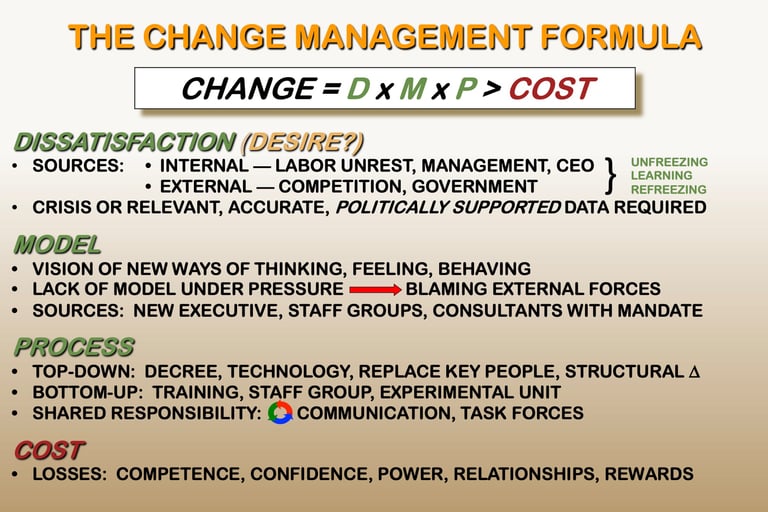
When successful change programs are examined there are certain variables present that are often missing in those that fail. We can go further and say this provides a highly reliable way to predict whether any proposed change will succeed. These variables combine in the Change Management Formula:
Change = D × M × P > Cost
Meaning: the probability of change rises when Dissatisfaction × Model/Vision × Process is strong enough to exceed the felt cost/losses of change. A Harvard Business School curriculum-change deck explicitly attributes this version to Professor Michael Beer and lists the same four elements. (Harvard Business School)
Change = D × M × P > Cost
This is not just a slogan. The multiplication matters. If any major factor is weak, the whole change effort collapses. High dissatisfaction without a model becomes anger. A model without dissatisfaction becomes a nice report. Process without a model becomes activity but with no result. All three must exceed the perceived cost of changing.
D — Dissatisfaction / Desire / Demand / Data
Your notes say “Dissatisfaction,” with “Desire?” in parentheses. The HBS version expands D as demand, data, discussion and diagnosis, desire, and direction. (Harvard Business School) That is useful because dissatisfaction alone can sound emotional or negative. Beer’s stronger meaning is: people must see a compelling reason to leave the current state.
Sources of dissatisfaction can be internal or external. Internal sources include labor unrest, executive concern, staff frustration, poor morale, turnover, low quality, safety problems, poor service, missed targets, or declining trust. External sources include competition, government pressure, customer expectations, technological change, legal demands, demographic change, media scrutiny, or public loss of confidence.
Your note that change requires “relevant, accurate, politically supported data” is important. In Beer’s world, data must not merely be technically correct; it must be accepted by the people who have enough power to block or support the change. For GSG, this translates directly: citizens need credible public dashboards, but those dashboards also need enough legitimacy that officeholders cannot simply dismiss them as partisan noise.
M — Model / Vision
The HBS version labels M as Model / Vision and says it should match strategy and values, be multidimensional, include modeling behavior, and use model organizations. (Harvard Business School) Your notes say: “vision of new ways of thinking, feeling, behaving.” That is exactly the organizational-change meaning.
A model answers: What does the better system look like? How will roles, relationships, decisions, incentives, information flows, and accountability change? It is not merely a statement of ideals.
For GSG, this is the difference between saying “we need better government” and specifying a model such as:
citizens define priorities → officeholders accept measurable goals → performance is tracked publicly → rewards and sanctions follow results.
Your note “lack of model under pressure → blaming external forces” is especially strong. When leaders face pressure without a credible model, they often default to excuses, scapegoating, symbolic gestures, or public relations. A model gives them a path other than blame.
P — Process
The HBS version expands P as participation, pronouncements, politics, performance appraisal, promotion, persistence, and planning. (Harvard Business School) Your notes list top-down, bottom-up, and shared-responsibility methods. That is a good way to organize it.
A serious change process has to answer: Who participates? Who has authority? What sequence will be followed? What will be piloted? What gets measured? How are conflicts handled? What consequences follow nonperformance?
Beer’s later work with Eisenstat and Spector strongly warns that change programs often fail when they are imposed as generic campaigns rather than built around real business problems. Their “critical path” emphasizes joint diagnosis, shared vision, consensus and competence, local adaptation, institutionalization, and ongoing adjustment. (Harvard Business Review)
For GSG, this is a major design lesson. A governance reform should not just be a “civic education campaign.” It needs process machinery: citizen agenda-setting, measurable goals, public review cycles, legislative response requirements, scorecards, hearings, corrective actions, and consequences.
C — Cost / Felt Losses
The HBS version defines C as cost / felt losses, including power, competence, self-esteem, relationships, rewards/status, security, and identity. (Harvard Business School) Your notes list competence, confidence, power, relationships, and rewards. That is very close.
This is one of the most valuable parts of Beer’s formula. People do not resist only because they are stubborn. They resist because change threatens something real or felt to be real:
Loss of competence: “I no longer know how to succeed.”
Loss of confidence: “I may be exposed as inadequate.”
Loss of power: “My discretion or status will shrink.”
Loss of relationships: “My allies, routines, and informal networks may be disrupted.”
Loss of rewards: “My pay, promotion path, prestige, or comfort may decline.”
Loss of identity: “This change says the old way, and maybe my life’s work, was wrong.”
For GSG, this helps explain why officeholders may resist performance measurement. Measurement threatens discretion, narrative control, incumbency advantage, symbolic politics, and low-accountability career patterns. A reform model has to reduce unnecessary fear while still making accountability unavoidable.
3. Related Beer framework: the “six steps” of effective change
Beer, Eisenstat, and Spector’s 1990 HBR article is a strong companion to your notes. Their basic argument is that many formal change programs fail because they substitute slogans, training, and structure changes for real work redesign. They recommend concentrating on task alignment: reorganizing roles, responsibilities, and relationships around a clearly defined performance problem. (In Zicht)
The six-step version commonly attributed to Beer/Eisenstat/Spector is:
Mobilize commitment through joint diagnosis of business problems.
Develop a shared vision of how to organize and manage.
Build consensus, competence, and cohesion.
Spread renewal without simply pushing it from the top.
Institutionalize renewal through policies, systems, and structures.
Monitor and adjust strategies in response to problems. (AvailAgility)
That sequence fits your D-M-P-C notes beautifully:
Joint diagnosis builds D.
Shared vision builds M.
Consensus, competence, spread, institutionalization, and adjustment build P.
Attention to competence, cohesion, and policy alignment reduces C.
4. GSG translation
For Gold Standard Governance, Beer’s formula could become a page or tool titled something like:
The Governance Change Formula
Reform = Dissatisfaction × Model × Process > Political Cost
Applied to government:
Dissatisfaction means citizens and leaders see credible evidence that current performance is unacceptable.
Model means there is a clear operating design for better governance, not just anger at politicians.
Process means there is a practical route for agenda-setting, measurement, review, correction, and consequences.
Cost means the perceived losses to officeholders, parties, agencies, donors, interest groups, and citizens must be understood and managed.
A useful GSG line might be:
Public anger does not create reform. Anger × model × process creates reform—if it is stronger than the cost of protecting the status quo.
1. Core source trail
The closest direct sources to your notes appear to be:
Michael Beer, “Leading Change,” Harvard Business School note, 1988.
Harvard Business Publishing describes it as a conceptual framework for understanding the process of leading organizational change. (Harvard Business School)
Michael Beer, Russell A. Eisenstat, and Bert Spector, “Why Change Programs Don’t Produce Change,” Harvard Business Review, Nov.–Dec. 1990.
This is the classic article where Beer and colleagues argue against overly programmatic, top-down change and emphasize business-problem diagnosis, task alignment, and change built through real operating work. (Harvard Business Review)
Michael Beer, Russell A. Eisenstat, and Bert Spector, The Critical Path to Corporate Renewal, Harvard Business School Press, 1990.
This appears to be the fuller book-length treatment behind the “critical path” and six-step renewal model. (Harvard Business School)
There is also a broader OD lineage behind the formula. The better-known D × V × F > R formula is usually traced to David Gleicher, later popularized through Richard Beckhard, Reuben Harris, and Kathie Dannemiller. In that version, D = dissatisfaction, V = vision, F = first steps, and R = resistance. (Jake Jacobs Consulting) Beer’s version appears to recast the middle terms as Model and Process, and the barrier as Cost / felt losses, which is more organizationally concrete.
Rule 2: Use the Change Management Formula
OTHER CONTENT
NAH MODEL EXTRACTED
TUL 3 TRACK FLOWCHART