
Measure Performance
Hold People Accountable for Results
Needed: A Practical Performance System
America does not suffer from a shortage of opinion. It suffers from a shortage of disciplined public accountability.
We measure athletes, students, hospitals, businesses, teachers, investments, and even customer service calls. But the people entrusted with public power are too often evaluated through noise, tribal loyalty, scandal, and after-the-fact disappointment.
That is not good enough. A serious republic needs a serious performance management system.
Not to replace elections, but to make elections smarter.
Not to punish honest failure, but to detect drift early.
Not to reduce leadership to numbers, but to connect leadership with results.
The goal is not government by spreadsheet. The goal is government with standards.
👉 No agenda. No accountability. No consequences. That's drift.
👉 Citizen priorities. Measured outcomes. Corrective action. That's governance.
As part of a balanced approach, officials should be measured according to their actual power, contribution and constraints—not blamed for every jurisdiction-wide outcome.
The Gold Standard Governance Proposal
GSG proposes a public performance compact for every significant office. The compact would include:
Role Definition
What powers does this office actually have?Citizen Priority Agenda
What do citizens identify as the top public needs?Performance Goals
What measurable objectives will the office holder pursue?Dashboard Indicators
What small and large measures will be tracked?Early Warning Triggers
What level of deviation requires public explanation?Corrective Action Rules
What must happen when performance falls short?Public Reporting Cycle
How often will citizens see progress?Consequences
How will pay, leadership roles, committee assignments, endorsements, or recall procedures connect to performance?


Rate Performance While It Is Happening
The review cycle should be frequent enough to matter. A suggested is seen below. The key is not merely reporting. It is correction. Every red or yellow indicator should require a written answer:
What is the deviation?
What caused it?
Who is responsible?
What corrective action is underway?
When will the measure return to standard?
What consequence follows if it does not?
This is how public management becomes serious.


"If you can't measure it, you can't improve it." —Drucker
Missing: Measures for Office Holders
Existing systems mostly measure programs, agencies, or departments. Gold Standard Governance should add a missing layer:
Office Holder Performance Review
This would not ask whether the official is conservative or liberal, popular or unpopular, loud or quiet. It would ask the questions that create a bridge between democracy and management. Citizens still decide values and direction. But performance measurement shows whether elected officials are actually delivering.
How to Create a Practical Performance System
A useful public performance system should include six layers (links below):
Duty and Work Discipline Measures
Priority Alignment Measures
Output Measures
Outcome Measures
Early Warning Measures
Integrity, Competence, and Stewardship Measures
Some governments have built pieces of a better system. (See Best Practices below). These are useful models. But they still tend to measure agencies more than elected office holders. Gold Standard Governance would go further.
The question is not simply: “Do people like this official?” The better question is: Is this office holder converting public authority into measurable public value?
That requires a dashboard that includes both small discipline measures and large outcome measures.
Leading measures show whether the office holder is showing up and doing the work.
Outcome measures show whether the work matters.
Build a Better Performance System for Public Office


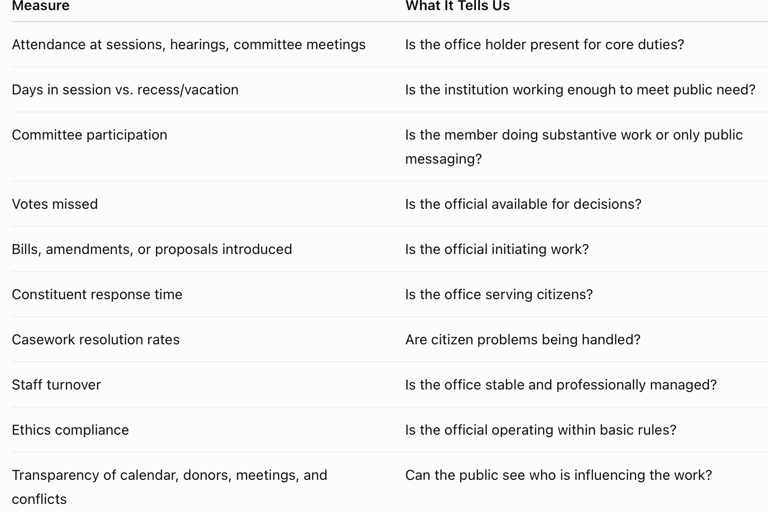

1. Duty and Work Discipline Measures
These are basic job-performance indicators. They do not prove effectiveness, but they show seriousness. These are “show-up” measures. They do not tell the whole story, but they create a floor.
A legislator who rarely attends, avoids committee work, has high staff turnover, hides contacts, and produces little work should not be able to hide behind slogans.
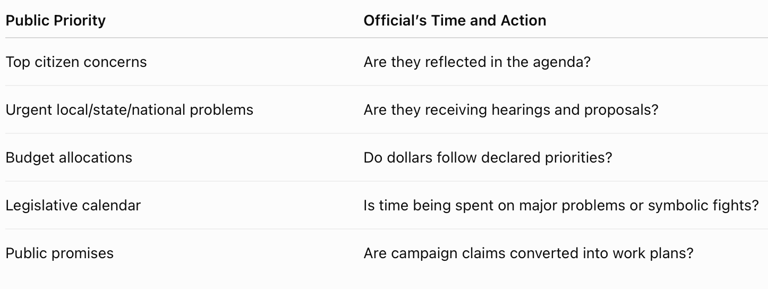

2. Priority Alignment Measures
The next question is whether the office holder is working on what matters.
Citizens care about major public needs: safety, schools, infrastructure, health access, cost of living, housing, water, energy, fiscal stability, border management, justice, economic opportunity, and government competence. This is where citizen agenda-setting becomes important.
Every year, citizens could identify a ranked list of public priorities. Office holders would then be measured against the degree to which they worked on those priorities, not merely against party talking points.
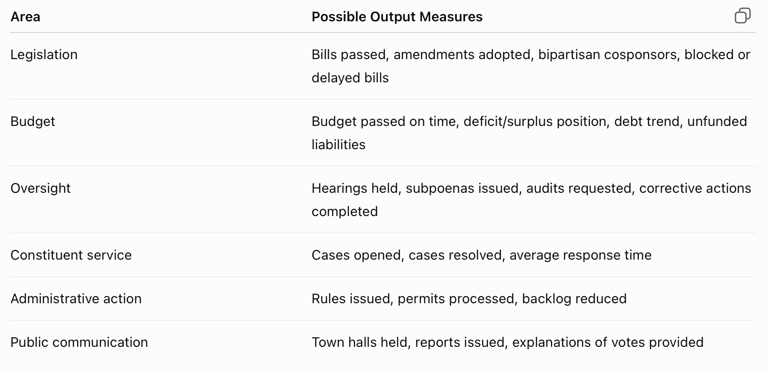

3. Output Measures
Outputs measure what government actually produces.
Output measures are necessary, but they can be misleading. A bad law is still an output. A flashy hearing may accomplish little. A large number of bills introduced may mean nothing if they are symbolic or poorly designed.
So effort must be tied to outcomes.
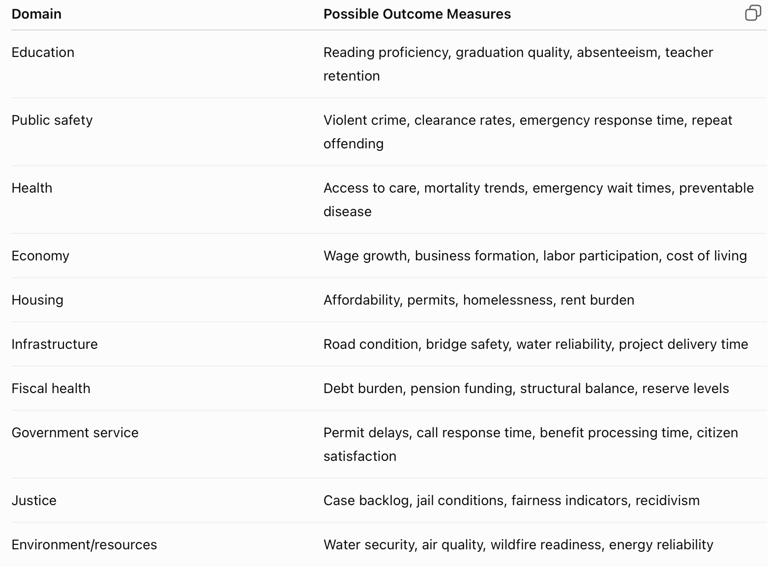

4. Outcome Measures
Outcomes ask whether public conditions improved.
This is where government performance becomes real.
A mayor should not be judged only by speeches about safety but by safety indicators. A governor should not be judged only by budget rhetoric but by fiscal condition, service reliability, and public outcomes. A legislator should not be judged only by ideology but by contribution to priority outcomes.
New Zealand’s Living Standards Framework is one example of broadening public measurement beyond narrow fiscal data by using wellbeing indicators to inform policy advice and cross-government priorities. (The Treasury New Zealand) The United Kingdom’s Outcome Delivery Plans similarly set department priority outcomes, strategies, and metrics used to track performance. (GOV.UK)

5. Early Warning Measures
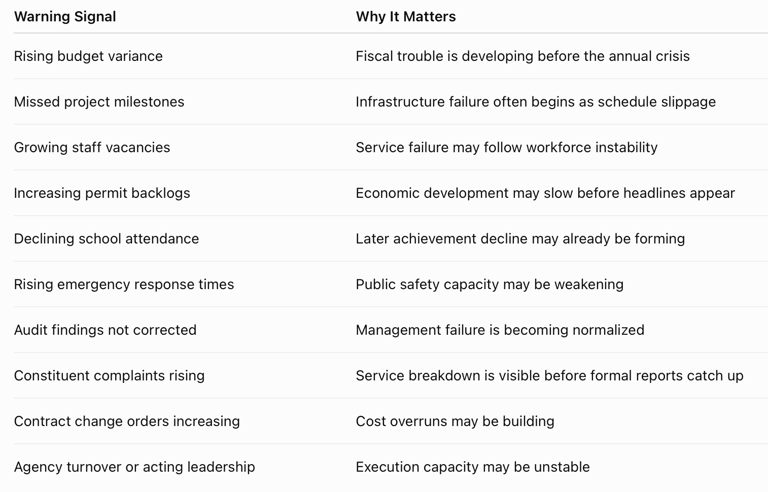
A good system spots deviation from standard early.
Waiting for a crisis is poor governance. The dashboard should include leading indicators, not just lagging results.
Gold Standard Governance should treat these as “dashboard lights.”
🟢 Green means on track.
🟡 Yellow means deviation requiring explanation.
🔴 Red means corrective action required.
⚫ Black means failure without credible recovery plan.
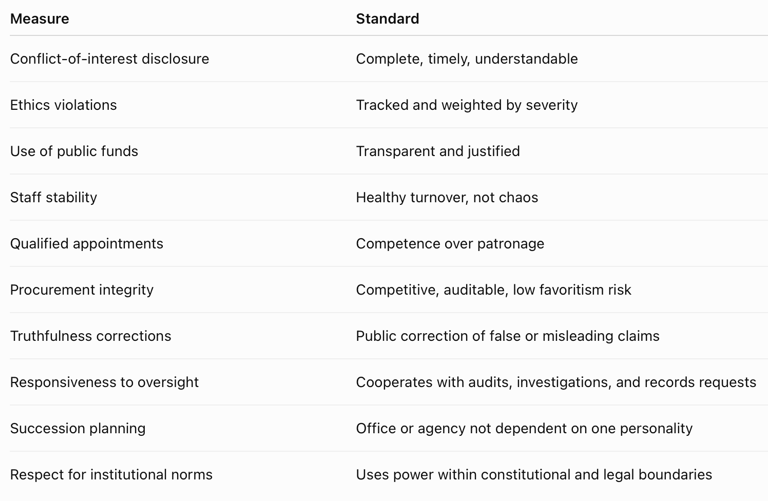
6. Integrity, Competence, and Stewardship Measures
Office holders do more than vote. They steward public trust.
A performance system should include measures of personal and institutional conduct.
This portion must be handled carefully. It should not become a partisan weapon. Measures should be factual, documented, and applied equally.

A Better Public Dashboard
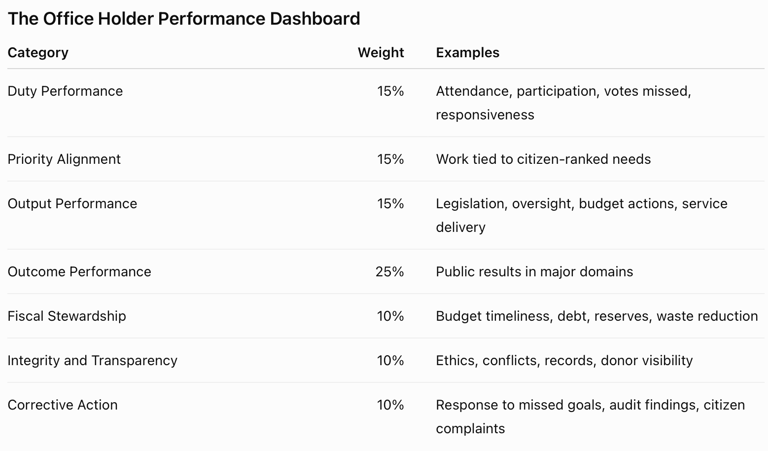
A citizen-facing dashboard could be organized around a simple scorecard.
The weights can be debated. The important point is that performance should not be reduced to popularity, ideology, or press coverage.

Best Practices to Consider
Several existing systems provide useful building blocks.
Performance.gov / GPRA Modernization Act
The federal model requires agencies to set strategic goals, annual performance plans, and reporting routines. It is useful because it establishes a formal goal-review discipline, though it is mostly agency-centered rather than office-holder-centered. (Performance)
OECD Performance Budgeting
The OECD model links budgeting to performance information so that spending decisions are informed by goals and results, not just political bargaining. (OECD)
Baltimore CitiStat
CitiStat became a well-known local performance model using frequent data review, follow-up, and agency accountability. Baltimore’s recent CitiStat reporting continues the idea of documenting what improved, what barriers remain, and what follow-up priorities exist. (City of Baltimore)
Maryland StateStat
Maryland adapted the CitiStat idea statewide, using frequently updated data and regular reviews to monitor service delivery. (World Bank)
New York City Mayor’s Management Report
NYC maintains a large public performance reporting system organized around agency goals and indicators. Its strength is breadth and transparency; its weakness, noted by critics, is that many measures still track activity more than true performance. (NYC Open Data)
Washington State Results / RPM
Washington’s performance system emphasizes data-driven performance management, alignment of policy, budget, and performance objectives, and fact-based decision-making. (Your Washington)
United Kingdom Outcome Delivery Plans
The UK model connects department priorities, strategy, and metrics. This is close to an MBO structure for government departments. (GOV.UK)
New Zealand Living Standards Framework
New Zealand’s framework is useful because it expands the definition of success beyond GDP and fiscal measures, incorporating broader wellbeing indicators. (The Treasury New Zealand)