
Change License
Government drift is not a mystery. It is a design flaw.
1⃣ Getting Started: Where citizens might begin
Citizens, civic groups, local leaders, and reform-minded officials can begin with practical steps:
1. Form a local Government Renewal group
Start with a small nonpartisan group committed to better functioning, not partisan victory. Think Win-Win, not zero sum.
The group’s purpose should be diagnosis before prescription.
Its first task is to ask:
What is broken?
How do we know?
Who is accountable?
What standards exist?
What happens when performance fails?
2. Create a public problem map
Before proposing solutions, map the system.
For a city, county, or state, identify:
elected offices;
major agencies;
boards and commissions;
budget flows;
public reporting systems;
ethics rules;
performance measures;
citizen complaint channels;
correction mechanisms.
The goal is to show citizens how the system actually works — and where it does not.
3. Build a citizen scorecard
Start with visible, understandable measures:
attendance;
budget performance;
promise tracking;
agency response times;
turnover in key offices;
audit findings;
major project delays;
debt and unfunded obligations;
public safety, education, infrastructure, and health outcomes.
A scorecard does not solve the problem by itself. It creates a shared factual base.
4. Ask officials to authorize a formal review
Citizens can ask councils, boards, legislatures, mayors, governors, or charter commissions to authorize a structured review of government functioning. This authorization represents a "change license" and avoids the appearance of being a rogue action.
The request should be framed carefully:
Not “adopt our ideology.”
Not “punish our opponents.”
But:
Create a lawful, public, systematic review of how this government functions, how performance is measured, and how failure is corrected.
5. Draft a model Government Renewal Commission ordinance or amendment
A strong proposal should define:
who appoints members;
how partisan balance is protected;
how citizens participate;
what records and data may be reviewed;
what topics must be examined;
what deadlines apply;
how recommendations are reported;
whether proposals go to voters, lawmakers, or both.
This turns public frustration into a usable legal pathway.
6. Use citizen assemblies or public panels
Complex reform needs public legitimacy.
Citizen assemblies, public panels, and structured deliberation can help ordinary citizens hear evidence, question experts, deliberate across differences, and recommend priorities.
This is especially important because system reform can otherwise be captured by insiders, activists, or narrow interest groups.
7. Start with one pilot jurisdiction
The best first victory may be local.
A city or county can become a demonstration site for GSG principles:
clearer public goals;
better candidate information;
outcome-linked budgeting;
annual governance scorecards;
public correction triggers;
charter review tied to performance.
A working example is more persuasive than a national manifesto.
2⃣ From Reform Ideas to System Change
Most efforts to improve government fail because they try to fix a systemic problem in a non-systemic way.
One reform here.
One candidate there.
One ethics rule.
One budget fight.
One election cycle.
One scandal at a time.
That is not transformation. That is patchwork.
Government malfunction is multi-faceted because government itself is a system: elections, candidate selection, legislative rules, budgeting, executive authority, agency performance, public reporting, accountability, ethics, and correction mechanisms all interact. When those parts are not aligned, failure becomes normal.
The challenge is not only to design a better model. The larger challenge is to obtain the public authority — the license — to review and redesign the system itself.
The GSG proposition
Government should be judged by whether it produces competent, ethical, measurable, and correctable performance for citizens.
That requires more than better speeches and better candidates. It requires a better operating system.
The immediate goal is not to impose a single reform package everywhere. The goal is to create a disciplined pathway for communities to examine their own governance systems and correct what is failing.
In that sense, the first reform is the right to review.
The first victory is the license to ask, publicly and systematically: Is this government designed to succeed?
If not, what must change?
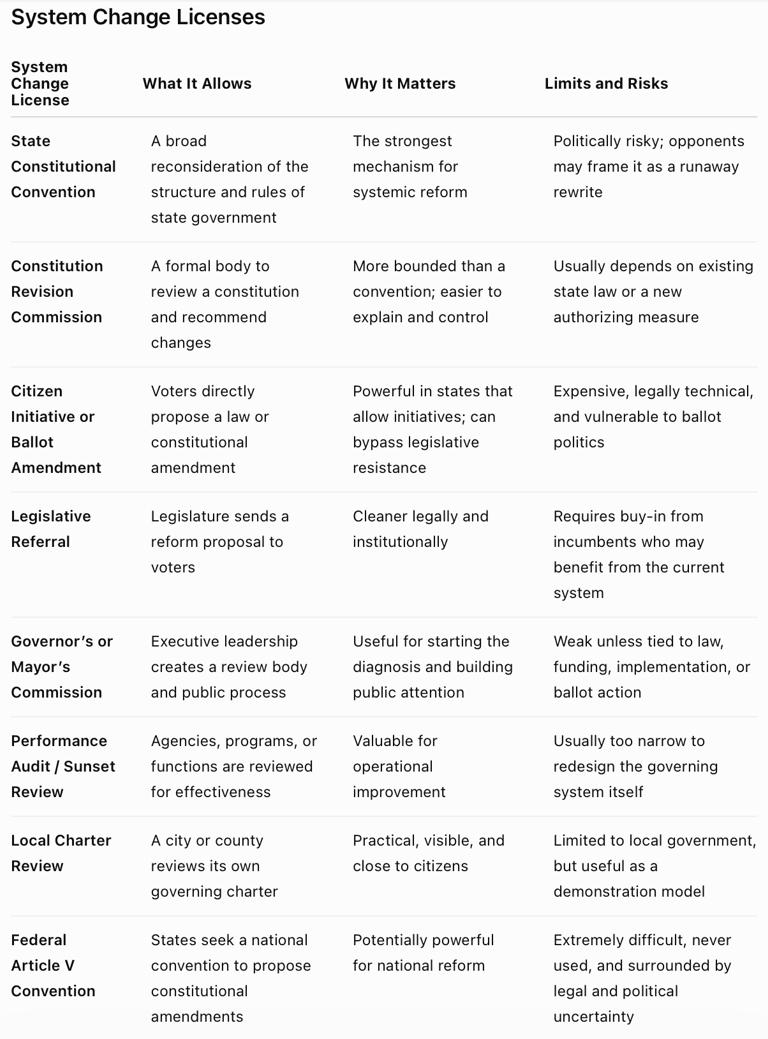

3⃣ Power Up with a System Change License

Be a Change Master
"Want a better world? Clean up your own front yard"
How do we move change from complaint to positive improvements? Here are some options to consider:
1⃣ Pick a starting point
2⃣ Move from reform ideas to system change
3⃣ Power up by getting a "license" for change
4⃣ A successful case study


4⃣ Case Study: The lesson from Michigan
A useful example comes from Michigan in the early 1960s.
George Romney helped lead a civic reform effort known as Citizens for Michigan, which studied the state’s needs and helped build support for a constitutional convention. Michigan voters approved the convention, delegates were elected, and the result was a new state constitution.
The lesson is not simply “hold a convention.”
The lesson is deeper:
First build the civic reform vehicle.
Then win authority to review the system.
Then produce a reform package.
Then submit it for public judgment.
That is the kind of disciplined pathway Gold Standard Governance seeks to encourage.
The missing step: a formal license to review government
In organizational transformation, serious change usually begins when leadership grants permission to examine the whole operating system.
In a business, that means authority to look across departments, incentives, roles, workflows, reporting systems, and outcomes.
Government needs the same kind of systematic review.
But in public life, that authority cannot simply be granted by a CEO. It must come from voters, law, elected leadership, constitutional process, or some combination of all four.
That is why GSG focuses not only on reform proposals, but on the mechanisms that make serious reform possible.