
Making Change
Calibrate Needs, Power Position, and Change Factor Sequence
Step 1: Understand Why Change Efforts Fail
To succeed at making change happen, start by understanding why change efforts fail. Research finds that change initiatives fail about 80% of the time. That working number applies across change efforts in business, education, and certainly in government. Failure analysis is helpful—understand what causes failure and avoid it.
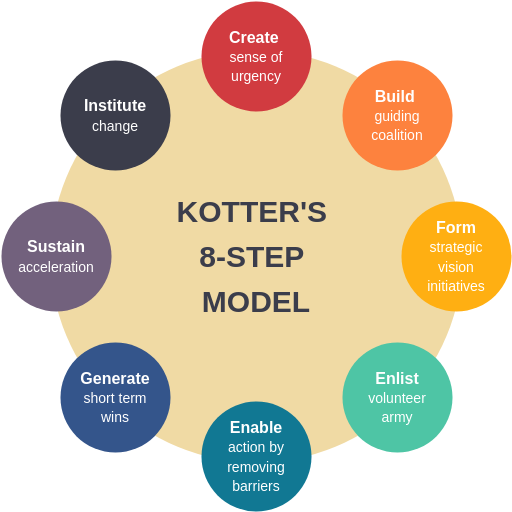
According to leadership expert John Kotter, change programs primarily fail because leaders rush the process and skip critical steps. Kotter identified eight common errors that derail transformation efforts, ranging from creating complacency to failing to embed new habits into the corporate culture. The Key Finding is don't fail to do any of these steps—omission means the change will crash.
Allowing Complacency Instead of Creating Urgency
Not establishing a great enough sense of urgency: Without a compelling reason to change, people won't rally behind the initiative.
Declaring victory too soon: Leaders often celebrate minor, early successes as the final war won, prematurely letting up on the momentum needed for deep, lasting change. [1, 2, 3]
Leadership and Vision Issues
Not creating a powerful enough guiding coalition: Change requires a dedicated, influential team to lead the charge; one person or a weak committee cannot drive large scale change.
Lacking a clear vision: If the direction of the change cannot be summarized in a simple, understandable way, it leads to confusion and disjointed efforts.
Under-communicating the vision by a factor of ten: Leaders often mention the new vision once or twice in a presentation and assume everyone is on board. It must be woven into daily operations and modeled constantly. [1, 2, 3, 5]
Execution and Alignment Lapses
Not removing obstacles: Bureaucracy, rigid structures, and resistant members can block the new vision.
Failing to create short-term wins: Large-scale change takes time. Without celebrating small, visible milestones, cynical people lose motivation.
Not anchoring changes in the group culture: If new behaviors aren't normalized into "the way we do things here," the organization will eventually revert to old habits once the change initiative ends. [1, 2, 3, 4]
Strategic Takeaway
To avoid these pitfalls, Kotter argues that change must be viewed as a deeply human, emotional journey rather than just a logistical or mechanical restructuring.

"You never change things by fighting the existing reality. To change something, build a new model that makes the existing model obsolete." — Buckminster Fuller
Steps on Success Ladder
What's needed to clean up the mess of bad outcomes? Look for options:
1⃣ Understand Change Failure
2⃣ Use Change Formula
3⃣ Assess Change Situation
4⃣ Manage Resistance
5⃣ Create Action Plan


Step 2: Use the Change Management Formula
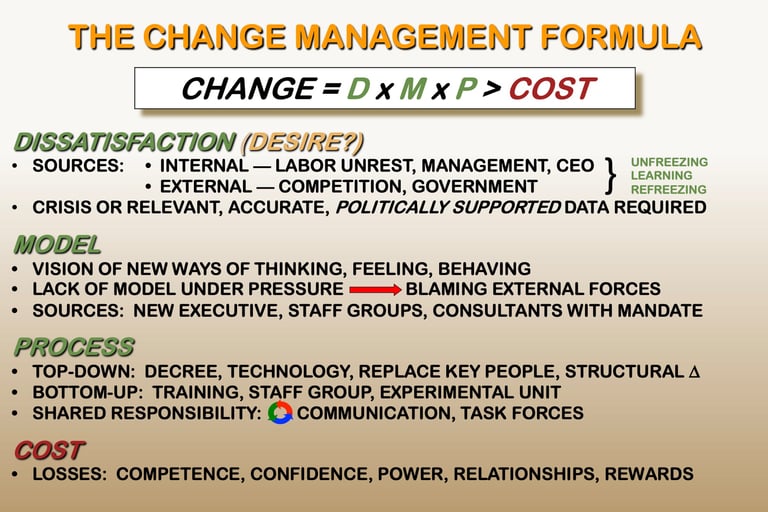
When successful change programs are examined there are certain variables present that are often missing in those that fail. This provides a highly reliable way to predict whether any proposed change will succeed. These variables combine in the Change Management Formula:
Change = D × M × P > Cost
Meaning: the probability of change rises when Dissatisfaction × Model/Vision × Process is strong enough to exceed the felt cost/losses of change. (This widely used model is credited to Dr. Michael Beer, Harvard Business School)
Change = D × M × P > Cost
This is not just a slogan. The multiplication matters. If any major factor is weak, the whole change effort collapses. High dissatisfaction without a model becomes anger. A model without dissatisfaction becomes a nice report. Process without a model becomes activity but with no result. The interaction of the three must be sufficiently positive that the benefits of change are greater than the costs of change.
D — Dissatisfaction / Desire / Demand / Data
Change most often occurs under conditions of dissatisfaction, not positive desire. D is the pressure to change, caused either by internal factors such as management or labor unrest, or by external forces such as competition or government regulations. D is the energy necessary for change to occur and is usually the result of a crisis, or of relevant, accurate and politically supported data. A key role for the manager is to increase D (Big D) in order to energize the people for change.
Sources of dissatisfaction can be internal or external. Internal sources include labor unrest, executive concern, staff frustration, poor morale, turnover, low quality, safety problems, poor service, missed targets, or declining trust. External sources include competition, government pressure, customer expectations, technological change, legal demands, demographic change, media scrutiny, or public loss of confidence.
Note: “relevant, accurate, politically supported data” is important. Data must not merely be technically correct; it must be accepted by the people who have enough power to block or support the change. For GSG, this translates directly: citizens need credible public dashboards, but those dashboards also need enough legitimacy that officeholders cannot simply dismiss them as partisan noise.
Application — Generating Dissatisfaction/Desire
Besides yourself, who will provide the energy for change? Who is dissatisfied with the present situation, or who desires a better way? How can other personal energy sources be brought into play to increase D? What/Who is going to drive the change through? A common failing is underestimating the amount of physical, emotional and intellectual energy that change requires. Do you and others have the staying power needed?
How can D be communicated or spread in the system? In what creative ways can D be increased? What information/example would help spread D and win change adherents ? What risks exist in increasing D?
M — Model / Vision
M = Model. M is the vision of the new way of doing things, the new way of thinking, feeling, and behaving. Creating a lot of D without M leads to blaming and fingerpointing---people don't know what to do. Most managers provide M, an adequate picture or plan, but fall down in providing P.
A model answers: What does the better system look like? How will roles, relationships, decisions, incentives, information flows, and accountability change? It is not merely a statement of ideals. For GSG, this is the difference between saying “we need better government” and specifying a model such as:
citizens define priorities → officeholders accept measurable goals → performance is tracked publicly → rewards and sanctions follow results.
Without a credible model, leaders under pressure often default to excuses, scapegoating, symbolic gestures or public relations. A model gives them a path other than blame.
Application — Creating an Adequate Model
What is the M? What specific model, plan ,or picture has been drawn up that specifies what the end result will be and how we get there step-by-step? How can this be clarified/simplified/visualized? What needs to be done to improve the model
Can implementation of the model be staged or broken down into component parts to make either communication or implementation easier?
Can a pilot of the model be installed and tested rather than having to just jump into things? Who would champion and defend the pilot test from those who are against it?
P — Process
P = Process. P is the way in which individuals or groups affected by the change have a chance to work through their resistance and reach a point of buy-in. Primarily the process is one of communication, participation, and time. The usual mistakes are top-down or bottom-up processing in which higher or lower levels of the organization try to influence the other. The best approach, where time allows, is a cyclical P where different levels lay out M and seek the reactions of others who are affected. Involvement almost invariably leads to buy-in.
A serious change process has to answer: Who participates? Who has authority? What sequence will be followed? What will be piloted? What gets measured? How are conflicts handled? What consequences follow nonperformance?
For GSG, this is a major design lesson. A governance reform should not just be a “civic education campaign.” It needs process machinery: citizen agenda-setting, measurable goals, public review cycles, legislative response requirements, scorecards, hearings, corrective actions, and consequences.
Application — Getting Buy-in from Stakeholders (Processing)
P is the term that describes how people reach a point of buy-in. Can others be made stakeholders in the change? What about the change can be made relevant to their interests? Can elements be negotiated, not compromised, to increase leverage to make others want to support the change?
What rewards/recognitions, can be provided to induce or support change compliance? How can rewards be reduced for other completing views. What's in it for those affected? Is an analysis of the stakeholders' position a good idea to determine what forces are affecting them? What glory can be shared?
Can those affected have a hand in shaping the model? Can they design it, test it, train in it before full implementation? Does their standing in the organization, skill level, or leadership affect this question?
Can the change be made fun, enjoyable, and positive? What sub-goals or early results can be celebrated? How can the satisfaction of achievement be made available and real? Celebration throughout the change is essential---how will it be sustained?
C — Cost / Felt Losses
C as cost / felt losses, including power, competence, self-esteem, relationships, rewards/status, security, and identity. competence, confidence, power, relationships, and rewards.
This is one of the most valuable parts of Beer’s formula. People do not resist only because they are stubborn. They resist because change threatens something real or felt to be real:
Loss of competence: “I no longer know how to succeed.”
Loss of confidence: “I may be exposed as inadequate.”
Loss of power: “My discretion or status will shrink.”
Loss of relationships: “My allies, routines, and informal networks may be disrupted.”
Loss of rewards: “My pay, promotion path, prestige, or comfort may decline.”
Loss of identity: “This change says the old way, and maybe my life’s work, was wrong.”
For GSG, this helps explain why officeholders may resist performance measurement. Measurement threatens discretion, narrative control, incumbency advantage, symbolic politics, and low-accountability career patterns. A reform model has to reduce unnecessary fear while still making accountability unavoidable.
Application — Benefit/Cost Ratio
Change will usually occur only if the benefits of D x M x P are greater than the costs.
Identify the benefits and costs of the change you're contemplating. Benefits might be economic, operating efficiency, personal or professional advancement, competitive advantage. Costs might include such things as expense, time and effort, organizational paralysis, threat to personal status, job security or competency.
Next, assign a weighting of 1-10 points for each element (1=low, 10=high), and total to see if benefits exceed costs by a substantial margin.
Step 3: Assess the Environment and Change Situation
A. History
Identify any significant history that will affect the change you are planning. What has happened in, around or about the change arena that you will be operating in? What occurred in the past that will have a present impact? (e.g., changes in management direction, competition, regulations, economics, morale, reporting relationships, new products, consultant reports)
B. Force Field Analysis
Change always occurs in a force field. Certain forces are pushing for the change, while other forces are restraining it. First identify what these forces are, then devise a plan for dealing with them.
Driving Forces are those that favor your change, and may include such things as the corporate culture, potential for profit, benefits and rewards, key sponsors and power people, or be a popular change. Identify all the driving forces operating in your situation. Are there other force factors that could be added to this list? How can each of these be strengthened or their potential increased?
What/Who are the driving forces?
How can these be strengthened?
Restraining Forces are those resisting the change, and may include such items as cost, lack of time, human insecurities, regulations/policy/precedent, opposition or relationships of key players, or simple inertia.
Identify all the restraining forces. Can any of these forces be removed from the list or neutralized?
Of those that remain, how can their influence be weakened or moderated?
C. Testing for Fit
"Look before you leap." The following steps are designed to help you think through whether it's possible to make the change you're contemplating. There are three tests---a failure on any one could represent a failure for your planned change.
Test 1: Is there a reasonable fit between the magnitude of the change being contemplated and your power in the organization? If no, is the change too big to be attempted? Can it be scoped down? What needs to be done?
Test 2: Is there a reasonable fit between the model/vision/goal of what exactly is to be done and the organizational realities/imperatives that form the context of the change environment? (What is it possible to do, here, in terms of the change itself?) If no, can the model be changed? What needs to be done?
Test 3: Is there a reasonable fit between internal change readiness on the part of key individuals and groups (their attitudes, skills, and dissatisfaction energy) and the change method you intend to use (either a Participative approach (work on people's attitudes first, then install the change) or a Directive approach (make the change first, then work on people's attitudes)? What needs to be done
Step 4: Deal With Resistance
Resistance to change is normal and to be expected. While the processing work you've planned will greatly reduce resistance, it's wise to plan on some problems arising. Which of the following resistance factors will be a part of your change situation?
A. Understand Why People Resist Change
1. Lack of Understanding or Poor Communication
Fear of the unknown.
Doesn't understand the change, or see the need for it.
Doesn't like the way in which the change was introduced.
Not communicated with about the change, or got the news second hand.
Inability to prepare. Not knowing how to perform.
2. Losses or Costs of Change
Perceived loss of job, relationships.
Comfort in the present way of doing things.
Feels the change will not be beneficial.
Too great a cost in terms of personal life, competence, confidence, relationships.
Fear of not fitting into the group norms or that change acceptance will lead to social isolation from peers.
Tossing out the present system seen as rejection of "my baby," the self investment and creativity put into current method.
3. No Participation or Control
Not asked regarding the change---a feeling of being a cog in the machine.
Minimal compliance or conformance, passive resistance as a way to mask their true feelings.
4. Attitudinal Problems or Emotional Reactions
Negative mindset about the job or organization to begin with and expresses it by resisting.
Change seen as personal criticism, a perceived slap at one's competence.
Doesn't like the person introducing the change, bad relationship history.
Personal immaturity, or possession of a "bad attitude".
Defense reactions (rationalizing, delaying, projecting blame) to protect comfort in the status quo.
Emotional coloring due to fear, anger, prejudice, frustration, hostility, insecurity, and resentment.
5. Legitimate Work Concerns
Bad timing, too much on one's plate already. Too much work to do already.
Insufficient resources or other cause of a perceived failure certainty.
Change seen as incorrect or unethical, a violation of values.
Told to change with no direction as to how or to what to do.
Change seen as overly complex, ambiguous, or with inadequate implementation plan.
B. Plan for Resistance
If you feel that the above resistance factors should be prepared for in advance, complete the following:
List individuals or groups you anticipate will be resistant.
Identify the factors underlying their resistance
Detail the approach you will take regarding the factors or people involved.
Public anger does not create reform. Anger × model × process creates reform—if it is stronger than the cost of protecting the status quo.
Step 5: Create the Final Action Plan, Identify Next Steps
The following items were found to be key in leading various change efforts. Use these battlefield proven questions to test the adequacy of your preparation and to give you a clear picture of where you are right now. Which of these are already accomplished? Which are items that need yet to be done?
A. Play into the Change Formula
Increase Dissatisfaction over the present way of doing things among sponsors or other affected groups.
Refine the Model. Make it simpler, more comprehensive, easier to understand, slicker.
Improve Processing by:
Establishing a Communications Plan
Talking with informal group leaders
Talking with key players singly or in group meetings
Setting up small groups to work on pieces of the project
Accepting workable suggestions
Announcing the change as far in advance as possible
Assess the total situation in terms of both planning and implementation
B. Control Situational Factors
Gain understanding of the history operating in this situation.
Factor the existing organizational culture into the plan.
Assess timing and appropriateness of the change given the amount of past change the target population had to deal with and the realities of the present situation.
Add to or strengthen the list of driving forces.
Shorten or weaken the list of restraining forces.
Add to the list of benefits. Find additional values to recommend the change (rewards, status, responsibility, achievement, autonomy, working relationships, etc.).
Reduce the list of costs or their penalty size.
Couple an unpopular change with a popular change or sweetener.
Gain the acceptance and respect of others as the change leader.
Test: Will it be possible for the change leader to sustain the physical, intellectual and emotional energy required?
C. Design the Work Plan
Correctly estimate the time and resources needed to support the change effort (everything takes longer, is harder, and costs more than one thinks). Are there built in time sinks, extra budget in case of delay or overruns?
Assess personal risks and risks to key political supporters.
Assess organizational risks.
Define fundamental commitments and redefined what needs changing.
Specify the process, the model, and the timeline.
Do the legitimate work of worrying and helped others deal with their worry work by engaging in joint planning (vs the rumor mill).
Be decisive on small common sense issues to cut against the grain of abounding uncertainty.
Prepare for the fact that more work than can possibly be anticipated will be required.
D. Be Politically Sensitive/Aware
Build coalitions and find support players to back the change effort.
Determine that timing is right.
Determine that you have the right opportunity to go for broke, or that change will have to be implemented incrementally.
Listen carefully to all constituencies.
Test: Have you been realistic, or bitten off more than you can chew?
Support people's personal planning and agendas in addition to planning for the project.
Acknowledge factional interests that merit consideration in order to diminish others exaggerated bargaining positions.
Pave the road to make movement toward the goal as smooth as possible.
Remember that change managing requires more emphasis on Processing than Model building.
Remember that people need leader support and people centered, not task centered, leadership in order to master change.

