Below is a tighter redraft suitable for a GSG Notebook / Resources section or as a Toolbox reference page.
Resource List: Organizations Working on Better Government Performance
Gold Standard Governance is not starting from an empty field. Many organizations already work on pieces of better government: data, evidence, public management, democratic health, citizen participation, budgeting, auditing, and leadership development.
What appears to be missing is a unified management systems approach that connects these pieces into one civic framework:
selection → priorities → goals → execution → measurement → public reporting → consequences → renewal
The organizations below are useful sources for ideas, methods, benchmarks, examples, and possible future partners. They do not replace GSG’s work. Rather, they show that many elements of the larger model already exist, though usually in separate lanes.
FOLLOWING TABLES, ONE HAS HEADLINE. OTHER NOT
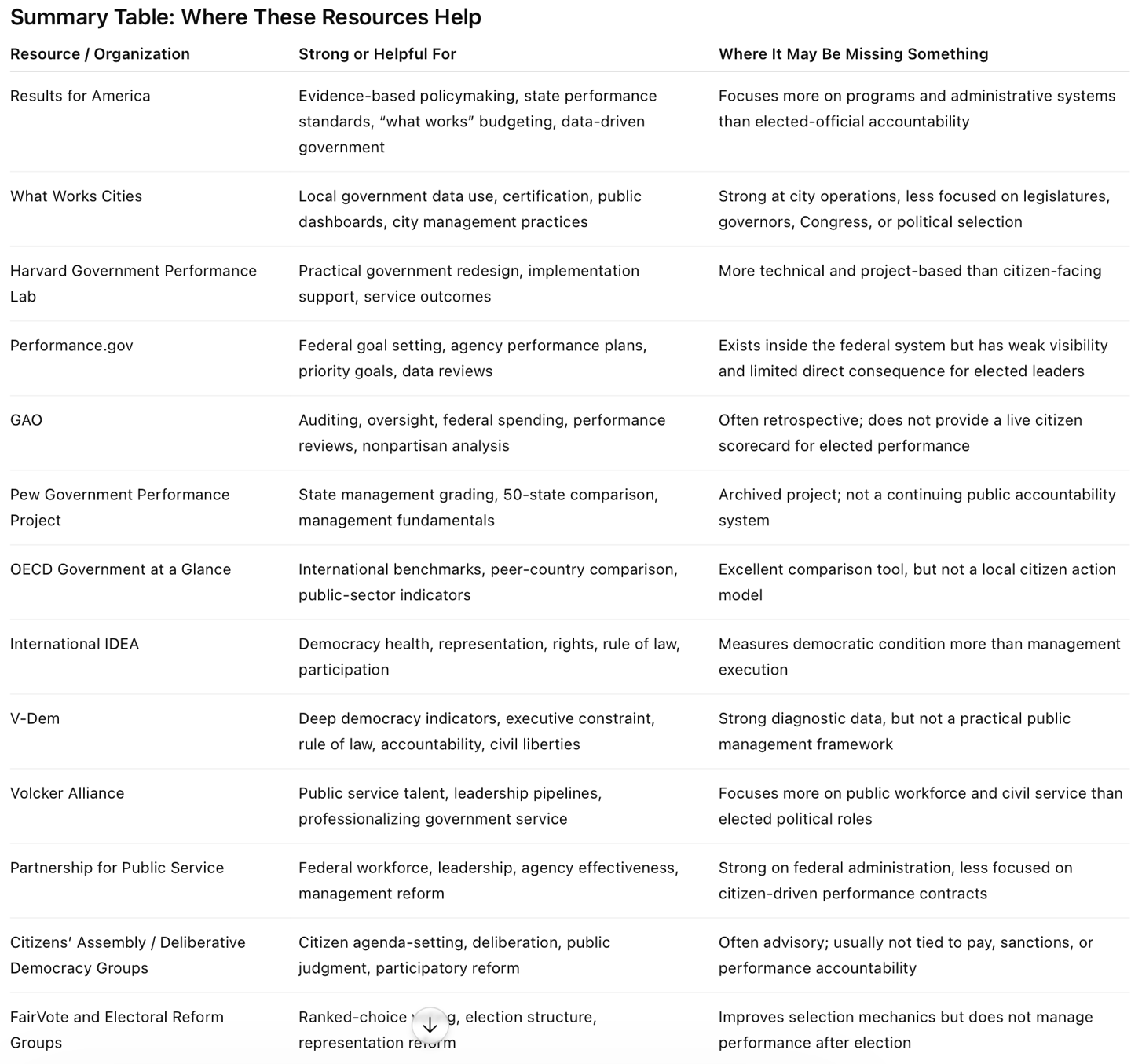
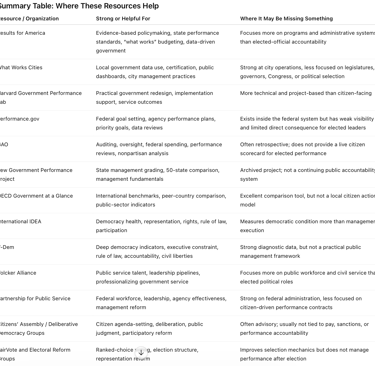
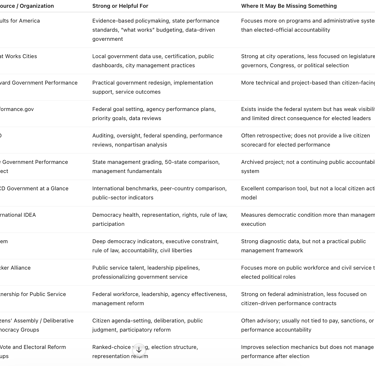
Summary Table: Where These Resources Help
Resource / OrganizationStrong or Helpful ForWhere It May Be Missing SomethingResults for AmericaEvidence-based policymaking, state performance standards, “what works” budgeting, data-driven governmentFocuses more on programs and administrative systems than elected-official accountabilityWhat Works CitiesLocal government data use, certification, public dashboards, city management practicesStrong at city operations, less focused on legislatures, governors, Congress, or political selectionHarvard Government Performance LabPractical government redesign, implementation support, service outcomesMore technical and project-based than citizen-facingPerformance.govFederal goal setting, agency performance plans, priority goals, data reviewsExists inside the federal system but has weak visibility and limited direct consequence for elected leadersGAOAuditing, oversight, federal spending, performance reviews, nonpartisan analysisOften retrospective; does not provide a live citizen scorecard for elected performancePew Government Performance ProjectState management grading, 50-state comparison, management fundamentalsArchived project; not a continuing public accountability systemOECD Government at a GlanceInternational benchmarks, peer-country comparison, public-sector indicatorsExcellent comparison tool, but not a local citizen action modelInternational IDEADemocracy health, representation, rights, rule of law, participationMeasures democratic condition more than management executionV-DemDeep democracy indicators, executive constraint, rule of law, accountability, civil libertiesStrong diagnostic data, but not a practical public management frameworkVolcker AlliancePublic service talent, leadership pipelines, professionalizing government serviceFocuses more on public workforce and civil service than elected political rolesPartnership for Public ServiceFederal workforce, leadership, agency effectiveness, management reformStrong on federal administration, less focused on citizen-driven performance contractsCitizens’ Assembly / Deliberative Democracy GroupsCitizen agenda-setting, deliberation, public judgment, participatory reformOften advisory; usually not tied to pay, sanctions, or performance accountabilityFairVote and Electoral Reform GroupsRanked-choice voting, election structure, representation reformImproves selection mechanics but does not manage performance after election
Key Resources
Results for America
Results for America is one of the closest resources for GSG’s purposes. Its Invest in What Works State Standard of Excellence is described as a national benchmark for how state governments use data and evidence to produce better results. (Results for America)
This is useful because it already frames government around evidence, outcomes, budget discipline, and measurable results. It offers language and examples that fit naturally with a management systems approach.
Its limitation is that it focuses mainly on state administrative performance and evidence-based programs. GSG can go further by asking how elected officials themselves should be selected, directed, measured, and held accountable.
What Works Cities
What Works Cities, supported by Bloomberg Philanthropies and led with Results for America, certifies local governments for their use of data to inform policy, allocate funding, improve services, evaluate programs, and engage residents. (What Works Cities)
This is a strong model for GSG to study because it shows that government performance can be publicly recognized, benchmarked, and certified. It also demonstrates that local governments can build a culture of measurement without making the subject overly academic.
Its limitation is scope. It is most useful for city operations and management practices. GSG’s broader question is how the whole democratic governing system should work, including elected officials, legislatures, candidate selection, public priorities, and consequences.
Harvard Kennedy School Government Performance Lab
The Harvard Government Performance Lab helps governments improve outcomes for communities and provides hands-on technical assistance to state and local governments. (GovLab)
This is useful because it moves beyond commentary into implementation. It deals with how governments actually redesign services, contracts, delivery systems, and outcomes.
Its limitation is that it is more of a professional implementation resource than a citizen-facing reform framework. GSG can borrow from its seriousness and practicality while translating the ideas into public language.
Performance.gov
Performance.gov describes the federal government’s performance framework, including goal setting, senior management engagement, priority goals, and data-driven reviews. This confirms that management logic already exists inside government. (OECD)
For GSG, this is an important point: the problem is not that performance management is unknown. The problem is that it is not sufficiently visible, forceful, citizen-directed, or tied to consequences for elected leadership.
Performance.gov is useful as a reference point, but it is not enough by itself. It does not give citizens a simple way to judge whether Congress, a governor, a legislature, or a president is doing the job well in real time.
U.S. Government Accountability Office
GAO is the federal government’s independent congressional watchdog. It examines how taxpayer dollars are spent and provides objective, nonpartisan, fact-based information to Congress and federal agencies. (GAO)
GAO is essential as a model of audit, investigation, oversight, and factual reporting. GSG can draw from GAO’s seriousness, credibility, and nonpartisan posture.
Its limitation is timing and form. GAO often reports after problems have developed. GSG’s emphasis is more preventive: a good management system should detect drift early, compare performance against goals, and make failure visible before damage compounds.
Pew Government Performance Project
Pew’s archived Government Performance Project evaluated how states managed money, people, infrastructure, and information. It used state report cards to connect management practices with government performance.
This is historically important for GSG because it shows that state government management can be assessed and graded. The idea is not unrealistic or impossible.
Its limitation is that it appears to have remained a project rather than becoming a widely used civic operating system. GSG can treat it as an important precedent and then ask: what would a modern, citizen-facing version look like?
OECD Government at a Glance
OECD’s Government at a Glance provides international indicators on government activity, resources, processes, outputs, outcomes, public trust, and public governance. (OECD)
This is one of the best sources for international benchmarking. It helps move the discussion away from slogans such as “America is number one” and toward measurable comparison with peer nations.
For GSG, OECD is especially useful for the claim that government should be judged by results that matter: health, education, economic security, public trust, infrastructure, justice, and institutional competence.
Its limitation is that it is a benchmark source, not a reform model. It tells us how countries compare. It does not tell citizens how to redesign their political accountability system.
International IDEA
International IDEA’s Global State of Democracy work organizes democratic performance around Representation, Rights, Rule of Law, and Participation. (International IDEA)
This is useful for the democracy-health side of GSG. It provides categories for judging whether a system is fair, lawful, representative, participatory, and institutionally sound.
Its limitation is that democracy health is not the same as management performance. A government can hold elections and preserve rights while still drifting, underperforming, avoiding priorities, and failing citizens on major outcomes.
V-Dem
V-Dem provides a large set of democracy indicators, including accountability, executive oversight, legislative constraints, rule of law, civil liberties, corruption, electoral integrity, and related measures. (V-Dem)
This is valuable for identifying institutional weakening, democratic backsliding, corruption risk, and loss of checks and balances.
For GSG, V-Dem can help define the guardrails. A management system for government must not only produce results; it must preserve constitutional democracy, lawful limits, civil rights, and institutional restraint.
Its limitation is usability. V-Dem is data-rich but not simple for ordinary citizens. GSG can translate this kind of material into plain-language scorecards and civic tools.
Volcker Alliance
The Volcker Alliance focuses on public service, government workforce capacity, leadership development, public service education, and connecting talent to government. (The Volcker Alliance)
This connects directly to GSG’s concern with selection quality. Government cannot perform well if capable people are not recruited, prepared, supported, and elevated.
The Volcker Alliance is especially useful for the “professionalizing government service” side of the model. Its limitation is that it focuses more on the public workforce than on the elected political class. GSG can extend the question: how do we professionalize the role of officeholder without turning democracy into technocracy?
Partnership for Public Service
The Partnership for Public Service works on improving federal government effectiveness, leadership, hiring, and public-service capability.
This resource is useful for understanding the federal talent system and the management problems of large agencies. It can help GSG distinguish between two related but different problems:
the competence of the permanent public workforce
the competence and accountability of elected and appointed political leadership
GSG’s special emphasis is on the second problem, while recognizing that both matter.
Citizens’ Assemblies and Deliberative Democracy Groups
Citizens’ assemblies, juries, panels, and deliberative democracy organizations explore ways for ordinary citizens to study issues, deliberate, and recommend public priorities. These are important for GSG’s interest in citizen agenda-setting.
This field is useful because it shows that citizens can do more than vote, complain, or answer polls. Properly structured, citizens can help define priority problems, evaluate tradeoffs, and create public direction.
The missing piece is consequence. Many citizens’ assemblies are advisory. GSG can ask a sharper systems question: what happens after citizens identify the priorities? Are elected officials required to respond? Are goals created? Are timelines attached? Is progress measured? Are rewards or sanctions connected to performance?
FairVote and Electoral Reform Organizations
Electoral reform groups such as FairVote focus on how elections are structured, including ranked-choice voting and representation reforms.
These groups are useful for the selection part of the GSG model. Better election design may improve candidate quality, reduce extremism, and make representation more accurate.
But electoral reform alone is not enough. Better selection does not guarantee better performance. GSG’s larger point is that government needs both:
better selection before office and better accountability after office.
How GSG Can Position Itself
Many organizations are working on fragments of better government. Some focus on evidence. Some focus on data. Some focus on democracy. Some focus on public employees. Some focus on elections. Some focus on citizen participation.
Gold Standard Governance can occupy the missing middle:
GSG brings these pieces into one management-system view of democratic government.
A possible positioning statement:
Gold Standard Governance is a citizen-facing management framework for democratic government. It asks not only whether government is legal, representative, or popular, but whether it is competently led, goal-directed, measurable, accountable, and improving.
Another shorter version:
Others measure programs, defend democracy, improve elections, or train public servants. GSG connects the whole chain: selection, priorities, execution, measurement, consequences, and renewal.
Why This Resource List Matters
These organizations provide useful building blocks, but none fully solves the larger systems problem:
Who selects candidates?
What qualifications should matter?
Who sets governing priorities?
How are goals defined?
How is performance measured while it is happening?
How are citizens informed before the next election cycle?
What consequences follow from failure?
How is public trust rebuilt through visible competence?
That is the space GSG is trying to organize.
The best use of this resource list is not to copy any one model. It is to draw from all of them and ask:
What would democratic government look like if it were managed with the same seriousness expected of any high-performing organization?
info@goldstandardgovernance.org
The Model
Approach
Context